I've head this statement countless times: "I've never been good at math...I will never understand math. It just never came naturally to me". I think this statement is so interesting since it goes completely against what we learned in class. According to Jo Boaler, EVERYONE can learn math to the highest levels. In fact, that is number 1 on her list of positive norms to encourage in math class.
There is such a strong stigma around math and many people think it is just black and white. The common belief is either you get math, or you don't. However, this is not the case. Mathematicians aren't born mathematicians are they? Absolutely not! It's something they work at and hone over time. As an educator, it's my goal to reverse this way of thinking. I know I will encounter many students who have had terrible experiences with math and will feel like giving up (or not even bother trying) because they have been fed this lie throughout their entire lives. Will some students have to work harder than others to comprehend math? Sure. But that's due to their different learning styles, not their capabilities. By saying that one isn't a "math person", we are capping their potential. Everyone has the ability to understand and make sense of math. It just comes down to their efforts.
Jo Boaler has some really good tips on how to encourage positive norms in math classes. Liisa shared them with us in class and I would like to share with all of you as well. They are listed below.

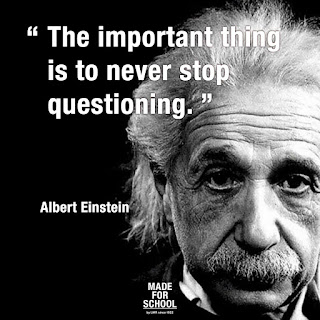
The third norm she lists is extremely important as well. Questions are the best way of learning. Sometimes students feel intimidated to ask questions because they don't want to seem stupid or incompetent. As Albert Einstein once said, "the important thing is to never stop questioning".
Ciao for now,
The Function(al) Teacher
There is such a strong stigma around math and many people think it is just black and white. The common belief is either you get math, or you don't. However, this is not the case. Mathematicians aren't born mathematicians are they? Absolutely not! It's something they work at and hone over time. As an educator, it's my goal to reverse this way of thinking. I know I will encounter many students who have had terrible experiences with math and will feel like giving up (or not even bother trying) because they have been fed this lie throughout their entire lives. Will some students have to work harder than others to comprehend math? Sure. But that's due to their different learning styles, not their capabilities. By saying that one isn't a "math person", we are capping their potential. Everyone has the ability to understand and make sense of math. It just comes down to their efforts.
Jo Boaler has some really good tips on how to encourage positive norms in math classes. Liisa shared them with us in class and I would like to share with all of you as well. They are listed below.

I think these 7 norms are so important and I will definitely be implementing them in my future classroom.
Number 2 is also a very good one. It is so important to stress that mistakes are valuable. This idea goes hand in hand with the growth mindset concept that I learned about in my other class. Exercising a growth mindset is when we encourage students by showing them that making errors is actually an opportunity for further growth and learning. Otherwise, they will just feel defeated and discouraged and will no longer want to try.
The third norm she lists is extremely important as well. Questions are the best way of learning. Sometimes students feel intimidated to ask questions because they don't want to seem stupid or incompetent. As Albert Einstein once said, "the important thing is to never stop questioning".

In light of my reference to mathematicians, here's the weekly joke concerning them:
Old mathematicians never die. They just lose some of their functions.
Ciao for now,
The Function(al) Teacher
Hi Mary, I completely agree with your point - these 7 norms promote a positive classroom environment and allow students to learn from themselves and their peers. I think as teacher candidates, creating a safe space is something that should be addressed the first day of class. Students need to feel welcomed and acknowledged before they can fully engage in their learning. This also helps the teacher as they will be able to understand where their students are at based on what they have to share in class.
ReplyDeleteGreat joke at the end, love the humour!